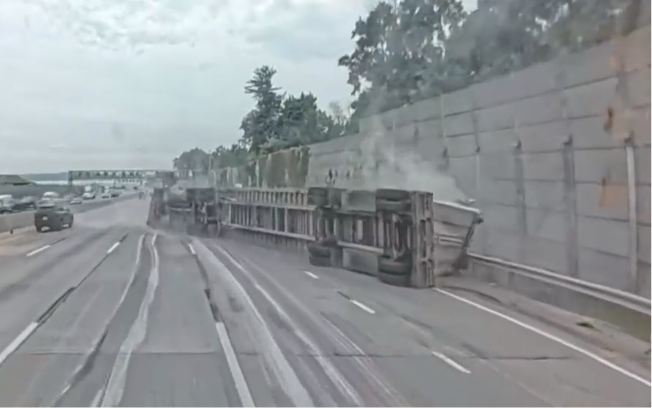
CLIFTON, NEW JERSEY — More than 24 hours after a tractor-trailer carrying dog food slammed into a limousine business and an adjacent home near Route 3 in Clifton, the truck remains lodged in the structure. Engineers are still working to stabilize the building before crews can safely remove the vehicle. Clifton Police called it “a very complex situation” with “no definitive timeline” for removal.
What Happened
The crash occurred at approximately 2:30 a.m. on Monday, April 13, near the Passaic Avenue exit ramp on Route 3 eastbound in Clifton. Surveillance video captured the dramatic moment — the truck never slowed down or veered before slamming into Limo Ride, a business on Kensington Avenue, and crashing into the adjacent home. The impact took out an entire corner of the building and knocked the home off its foundation.
The driver was trapped inside the crushed cab. First responders extricated him and transported him to the hospital with non-life-threatening injuries. A man inside the home was rescued from a second-floor window. Remarkably, he was not injured.
pix11
The Damage
Deputy Fire Chief William LeGates described the extent of the structural damage. “The building was at least 8 or 12 inches out of square. It’s leaning, it’s very precarious in there. The guy said the roof was collapsed onto the cab and the cab was totally crushed,” LeGates said.
Neighbor Leticia Feliciano described the moment of impact. “My husband thought we were being bombed. He really did. He thought that a bomb was dropped,” Feliciano said.
Why the Truck Is Still There
As of 1 p.m. on Tuesday, April 14, the truck remained embedded in the building. Engineers are calculating how to safely support the structure at key points before the truck can be towed out without risking a collapse. “The priority is getting this right,” Clifton PD said.
The Passaic Avenue exit ramp on Route 3 eastbound remains closed. Route 3 is open in both directions. The cause of the crash is still under investigation.
📸 Image(s) used under fair use for news reporting.
WASHINGTON COUNTY, TEXAS — The man accused of stealing a semi-truck and intentionally ramming it into a Texas Department of Public Safety office in Brenham in 2024 — killing two people and injuring 12 others after being denied his commercial driver’s license — has been deemed incompetent to stand trial, Washington County District Attorney Derek Estep confirmed.
Clenard Parker, now 44, drove a stolen 18-wheeler into the Brenham DPS office on April 12, 2024, days after being denied his CDL. Two people died. Twelve others were injured.
Where the Case Stands
In the summer of 2025, a psychiatric evaluation resulted in Parker being committed to a secure, lockdown facility designated by the Texas Health and Human Services Commission that specifically houses individuals charged with violent crimes. Psychiatrists at the facility are working to restore Parker’s competency.
Under Texas law, competency is evaluated based on a person’s present mental state — not their state of mind at the time of the crime. “The finding is made initially by a psychiatrist after an evaluation,” Estep explained.
Parker can be held under the current order for up to one year or until doctors determine his competency has been restored. That review is coming up this summer.
“Theoretically, either party could challenge the decision made by those doctors at the state hospital, try to find and hire a doctor who would testify that the first doctors are wrong, and demand a jury trial on his competency. However, even that extreme measure would first require a competency determination to be made,” Estep said.
Two Possible Outcomes
If doctors determine Parker’s competency has been restored, he will return to Washington County and the case will proceed to trial. If doctors determine he is still incompetent and his competency is unlikely to ever return, Parker could be committed to the state hospital for the remainder of his life.
📸 Image(s) used under fair use for news reporting.
DELAWARE COUNTY, OHIO — The Columbus truck driver accused of plowing into stopped traffic and killing a family of three on Interstate 71 made his first court appearance Monday. Prosecutors upgraded his charge to aggravated vehicular homicide and said additional charges are expected.
Modou Ngom, 50, of Columbus, appeared in Delaware County Common Pleas Court on Monday. The court set a $500,000 cash surety bond and ordered Ngom not to drive. A preliminary hearing is scheduled for April 21 at 3 p.m. If convicted, Ngom faces between 12 and 60 months in prison. State prosecutors said they anticipate filing more charges.
ODOT
What Happened
The crash occurred at approximately 6:27 p.m. on Saturday, April 12, on northbound I-71 near the U.S. Route 36/State Route 37 exit in Delaware County. The area was part of an active construction zone connected to the ODOT Sunbury Parkway project, with concrete barriers in place and traffic slowed and redirected. Approximately 20 vehicles were stopped in the right lane attempting to merge off I-71 at the Tanger Outlet exit.
ODOT
Ngom’s semi-truck and trailer failed to stop for the backed-up traffic and slammed into several vehicles from behind, triggering a nine-vehicle chain reaction. Newly released ODOT video captured the moment the semi struck a stopped pickup truck. A man and woman in their 30s and their 1-year-old child, all from Ashley, Ohio, were traveling in a Chevrolet and were killed in the crash. Three other people sustained injuries but are expected to survive. I-71 closed in both directions near the crash site for several hours Saturday evening.
ODOT
It remains unclear what caused the crash. Investigators have not confirmed whether speed or the construction zone played a contributing role. The Ohio State Highway Patrol is leading the investigation and did not respond to media inquiries on Monday.
ODOT
According to OSHP, Delaware County recorded 13 fatal crashes in 2025 and 19 in 2024.
All defendants are presumed innocent until proven guilty in a court of law.
📸 Image(s) used under fair use for news reporting.
KANSAS CITY, MISSOURI — A Kansas City man is behind bars after shooting a tow truck driver in the abdomen and kicking him in the head following a dispute over how the driver was handling a tow, according to Platte County court records. The driver underwent emergency surgery and remains in critical condition.
At approximately 2:10 a.m. on April 4, Kansas City Police Department officers and Platte County Sheriff’s deputies responded to the area of Northwest 70th Street and Northwest Mokane Avenue for a reported shooting. Platte County deputies arrived first and found Ezekial Z. Doss, 33, kneeling near two trash bins, attempting to conceal a firearm underneath one of them. They found the victim, Matthew Solberg, a driver for Maxx Towing, in the cab of his tow truck with a gunshot wound to the abdomen. Deputies rendered aid until medics arrived. Kansas City Fire Department EMS transported Solberg to North Kansas City Hospital for emergency surgery. As Doss was taken into custody, he told deputies spontaneously: “That’s not my gun.”
What Led to the Shooting
Court records say Doss told investigators that around 11 p.m. or midnight, his 2021 Dodge Charger suffered a flat tire on northbound 635 Highway after hitting something in the road. He called for a tow truck. When Solberg arrived and began loading the Charger, Doss said Solberg became combative and told him he could not ride in his Charger during the tow and would have to sit in the cab instead. Doss sat in the passenger seat. He said the two argued during the drive to his residence, with Solberg at one point threatening not to take him home.
Once they arrived, Doss claimed Solberg punched him unprovoked while the car was being unloaded. He said a fight broke out and that his pistol fired from his pants while he was on the ground with Solberg on top of him. He said he tried to hide the gun because he did not want it in his hand when police arrived. According to court records, the tow truck driver never threatened Doss’s life.
Witness Accounts
One witness told investigators he heard yelling outside his apartment, looked out, and saw Doss arguing with Solberg on the driver’s side of the tow truck. He then heard a gunshot and looked back to see Solberg on the ground with Doss standing over him. Another witness, Doss’s fiancée, said she heard yelling and saw Solberg hit Doss in the head. As she was exiting her apartment, she heard a gunshot. When she reached Doss, he told her “He hit me.” A third witness partially captured the argument on a Ring camera. The footage showed the dispute and Doss reaching into his pockets, but investigators could not confirm whether he was holding an object when he extended his arm toward the truck.
Charges and Bond
Doss faces one count of second-degree assault in Platte County Circuit Court. He is being held at the Platte County Jail on a $250,000 cash-only bond. His first court appearance is scheduled for Tuesday at 8:15 a.m.
Industry Response
The Missouri Tow Truck Association is asking the public to support Solberg as he recovers. “This is the reality of what our operators face,” the MTTA said. “When one of us is down, we step up.” Donations can be made in person at an MTTA meeting or by mailing a check to the MTTA at P.O. Box 1221, Liberty, Missouri 64069.
All defendants are presumed innocent until proven guilty in a court of law.
📸 Image(s) used under fair use for news reporting.
PENDLETON, INDIANA — Indiana State Police conducted a four-hour directed enforcement patrol targeting distracted driving on Interstate 70 on April 10, 2026, making 153 traffic stops and uncovering 45 violations across 16 commercial vehicle inspections.
The patrol covered I-70 from mile marker 69 to mile marker 156 at the Ohio/Indiana state line, spanning the Indianapolis and Pendleton Districts. Troopers focused on cell phone use and other unsafe driving behaviors.
Indiana State Police said they remain committed to ensuring the safety of all motorists through targeted enforcement and education. Drivers are reminded to stay alert, avoid distractions, and focus solely on driving while traveling through Indiana.
📸 Image(s) used under fair use for news reporting.
NORTH AMERICA — The Commercial Vehicle Safety Alliance’s International Roadcheck inspection blitz is coming up May 12-14, 2026, covering the United States, Canada, and Mexico. Here is what commercial drivers need to know before it arrives.
What Is International Roadcheck?
International Roadcheck is the largest targeted commercial vehicle enforcement program in the world. During the 72-hour event, CVSA-certified inspectors conduct an average of nearly 15 trucks and motorcoaches per minute across North America. Since its launch in 1988, roadside inspections during Roadcheck have totaled more than 1.8 million. Inspectors man weigh stations, inspection stations, and pop-up inspection sites to perform the North American Standard Level I Inspection, which covers both the driver and the vehicle.
This Year’s Focus Areas
Each year CVSA selects two areas of emphasis. For 2026, the driver focus is on electronic logging device tampering, falsification, or manipulation. The vehicle focus is on cargo securement.
What Inspectors Will Check
During the driver portion, inspectors will review driver qualifications, license, record of duty status, medical examiner’s certificate, seat belt usage, skill performance evaluation certificate if applicable, Drug and Alcohol Clearinghouse status in the U.S., and signs of drug or alcohol impairment. Any critical violations will result in the driver being placed out of service.
During the vehicle portion, inspectors will check brake systems, cargo securement, coupling devices, driveline and driveshaft components, driver’s seat, fuel and exhaust systems, frames, lighting devices, steering mechanisms, suspensions, tires, wheels, rims, hubs, and windshield wipers. Critical safety violations will result in the vehicle being placed out of service.
Commercial vehicles that pass a Level I or Level V inspection without critical violations may receive a CVSA decal, signaling to enforcement personnel that the vehicle was recently inspected and cleared.
Participating Agencies
Roadcheck is sponsored by CVSA with participation from the Federal Motor Carrier Safety Administration, the Pipeline and Hazardous Materials Safety Administration, the Canadian Council of Motor Transport Administrators, Transport Canada, and Mexico’s Ministry of Infrastructure, Communications and Transportation.
📸 Image(s) used under fair use for news reporting.
TAMPA, FLORIDA — The Florida Office of Agricultural Law Enforcement arrested a Tampa man on April 13, 2026, after investigators found he had sold 23 semi trailers with falsified vehicle identification numbers to a single victim, causing more than $287,000 in financial losses.
OALE launched an investigation into multiple commercial semi trailers suspected of carrying fraudulent VINs. Investigators identified a victim who had purchased all 23 trailers from Michael Sancillena and his companies — Catam Truck, LLC, Tampa Trucks, LLC, and JCA Transport Services, Inc. Every one of the 23 trailers contained a fraudulent VIN. OALE seized 18 of the 23 trailers and confirmed the fraudulent VINs on each.
Sancillena faces one count of felony grand theft and five counts of felony selling or possessing vehicles with altered numbers.
All defendants are presumed innocent until proven guilty in a court of law.
📸 Image(s) used under fair use for news reporting.
LANCASTER, PENNSYLVANIA — On the morning of July 5, 2010, Eileen Miller sat on her front porch and watched two state troopers pull up to her house. She said she immediately knew it involved her son. Paul Miller Jr. was 21 years old. A tractor-trailer driver had reached for a cell phone, lost control, crossed three lanes, went through a grassy median, and struck Paul’s car head-on, pushing it into an embankment. A van carrying 12 people then hit the tractor-trailer. Paul was the only person killed.
It took Eileen Miller 14 years to turn that morning into a law.
The Crash and What Followed
Miller said she did not initially know distracted driving had caused the crash. After crash reconstruction, she learned the truck driver had been reaching from one phone to another that was jammed under his seat. She made a promise at the morgue that she would find out what caused the crash and fight to change it.
She was originally told the driver would receive only probation. She fought for a stronger sentence. After the crash, the driver received another citation in New Jersey for phone use, as well as another unsafe driving citation. The judge ultimately rejected the plea deal and sentenced him to one to three years in prison. He served 17 months. After his release, Miller met with him. He admitted he had been distracted.
14 Years of Advocacy
Miller began contacting state representatives and traveling to the Capitol to advocate for a hands-free driving law. Pennsylvania already had a texting law, but Miller said it was difficult to enforce because officers could not easily tell whether someone was texting, scrolling, or doing something else. In her son’s case, the driver had not been texting at all.
Opposition came from multiple directions. Some objected on personal freedom grounds. Others did not want to give up phone use themselves. Some lawmakers wanted data to ensure enforcement would not lead to profiling, which Miller said she understood. She credited Pennsylvania State Sen. Rosemary Brown with helping move the legislation forward after hearing her story.
Paul Miller’s Law took effect on June 5, 2025. It makes handheld phone use while driving a primary offense, meaning police can stop a driver solely for holding a device. Drivers cannot use a handheld phone even while stopped in traffic, at a stop sign, or at a red light. They must pull off the road to make a call. Hands-free options such as Bluetooth or speakerphone remain permitted. Drivers cannot hold or support a phone with any part of their body.
Miller said she was proud the law finally passed because her son’s legacy would help save lives. At the same time, she said it was painful that it took losing him to get there. She said the best practice is for drivers to turn phones off completely and set navigation before getting on the road.
She has continued advocating on the roads. When she sees drivers using phones, she sometimes approaches them afterward and hands them a hands-free device. “They do not want to kill someone else or themselves,” she tells them.
Law Enforcement Perspective
Pennsylvania State Police Trooper James Grothey, public information officer for PSP Troop J, said distracted driving causes more crashes than impaired driving. Cell phones are a major source, but anything that takes a driver’s eyes off the road counts — reaching for objects, doing hair or makeup, dealing with children in the back seat, or looking at crashes on the side of the road.
Under Paul Miller’s Law, the base fine is $50. With court costs, the total runs approximately $180 to $200. Violations can affect a driver’s record, insurance rates, and employment, particularly for jobs that involve driving. Grothey said professional drivers should be held to a higher standard. He also noted that even hands-free conversations can be distracting if a driver’s attention drifts from the road.
AAA’s Perspective
Doni Lee Fox, public relations manager for AAA Central Penn, said the AAA Foundation for Traffic Safety’s most recent Traffic Safety Culture Index survey found that 90 to 97 percent of drivers acknowledged it was dangerous to text, read emails, or take phone calls while driving — yet 27 to 39 percent admitted doing it anyway.
Fox said publicizing statistics and strengthening laws are part of changing behavior. Her advice: set GPS, adjust the radio, handle climate controls, and settle children before getting on the road. Put the phone away and turn off notifications before driving.
Key Facts About Distracted Driving in Pennsylvania
Distracted driving killed 3,275 people nationwide in 2023, according to NHTSA. Pennsylvania court records show more than 9,000 distracted driving offenses between 2021 and 2025. Drivers in their 20s and 30s were the most common offenders. Violations peaked between 2 p.m. and 4 p.m. In the Susquehanna Valley in 2025, York County recorded the most distracted driving offenses at 102, followed by Lancaster, Dauphin, Franklin, Cumberland, Lebanon, Adams, and Perry counties. Juniata and Mifflin counties reported no offenses in 2025. Texting while driving is illegal in 49 states, the District of Columbia, and Puerto Rico.
April is Distracted Driving Awareness Month — a timely reminder for commercial motor vehicle drivers that distraction behind the wheel carries consequences far beyond a typical passenger vehicle accident.
According to the Federal Motor Carrier Safety Administration, a 2009 study found that 71% of large-truck crashes occurred because the driver was doing something other than driving. In 2024, distracted driving contributed to more than 3,200 motor vehicle fatalities nationwide.
Driver distraction is defined as any diversion of attention away from activities critical to safe driving. Distractions can come from inside the cab — texting, dialing, eating, adjusting the radio, using a dispatching device — or from outside, such as billboards, buildings, or people. The FMCSA offers the following guidance for commercial drivers.
Don’t Let Outside Objects Pull Your Attention
Anything taking your eyes away from the road is a distraction. A 2006 study found that driver inattention was the leading factor in crashes and near-crashes, with nearly 80% of crashes involving some form of inattention in the three seconds before impact. A separate three-year FMCSA and NHTSA data collection effort estimated that 11,000 truck crashes involved distractions external to the cab.
No Texting While Driving
Texting while driving is illegal for CMV drivers. A 2009 study found that text messaging while driving increased a driver’s chances of being involved in a safety-critical event by 23 times. Drivers who were texting spent nearly five seconds looking at their phone in the moments before a critical event. At 55 mph, five seconds of inattention means traveling the length of a football field without looking at the road. That study was so significant it prompted FMCSA to ban texting for commercial drivers and led President Obama to issue Executive Order 13513 banning federal employees from texting while driving on government business.
No Dispatching Devices While Driving
Using a dispatching device while driving — sometimes called a mobile or portable data terminal — increases a driver’s chances of a safety-critical event by nine times, according to a 2009 study. Many companies lock out these devices when the truck is moving. Some newer devices can read messages aloud and accept voice responses to reduce the need to look at a screen.
No Dialing a Handheld Phone While Driving
Dialing a handheld phone while driving is illegal for CMV drivers and increases crash risk by three times, according to a 2010 study. A 2011 study also found that drivers dialing a handheld phone made more frequent and larger steering corrections than those simply talking. If a call is necessary, pull over safely, keep it short, or use a voice-activated hands-free system.
No Reading, Writing, or Using Paper Maps While Driving
Reading while driving increases the risk of a safety-critical event by seven times. Writing while driving increases it by eight times, according to a 2009 study. If directions or notes are needed, pull off the road. GPS units are safer than paper maps but should never be programmed while moving. Many newer units accept voice input to eliminate the need to look away from the road.
Avoid Eating and Drinking While Driving
Eating behind the wheel takes at least one hand off the wheel and can take eyes off the road. Research has found that eating while driving is riskier than talking on a cell phone. In May 2008, a CMV driver distracted by drinking a soda struck a stopped school bus that was letting children off on Highway 50 in Kenosha County, Wisconsin. Fourteen children went to the hospital, four with serious injuries. The driver was hospitalized in critical condition.
FMCSA urges drivers to eat before getting behind the wheel or to pull over when it is time to eat or drink.
📸 Image(s) used under fair use for news reporting.
A 60 Minutes investigation has found that a practice known as “chameleon carriers” — where trucking companies dissolve and re-register under new names to erase their safety records — may be occurring at tens of thousands of commercial trucking companies across the United States.
The practice allows carriers to shed safety violations, crash histories, and federal enforcement actions by obtaining a new Department of Transportation number. The DOT number is the federal ID used to track a carrier’s safety history. When it changes, the history disappears. According to trucking safety consultant Rob Carpenter, the entire process takes about 21 days and $1,000.
How It Works
Carpenter, a 25-year trucking veteran who tracks chameleon operations, said the registration system has no meaningful barriers. “There’s no requirement to own a trucking company that you be an American. You can start it from anywhere in the world. $1,000, pay online, say you are who you say you are, and you’ve got a trucking company,” Carpenter said.
Once a new identity is established, the carrier appears clean to brokers and shippers. “You’ve got no violations. You’ve got no crashes. You’re just a clean carrier to them,” he said. Carpenter estimates 10% to 20% of the roughly 700,000 trucking companies in the United States operate somewhere in the chameleon carrier spectrum. According to data from risk assessment firm Fusable, chameleon carriers are four times more likely to be involved in crashes. They contributed to more than 5,300 truck-related deaths in 2024.
Super Ego Holding
The investigation focused on Super Ego Holding, a network of trucking and leasing companies based in Serbia and the United States. The company is under federal investigation and named in a class action lawsuit filed by more than 800 truckers. Regulators and former employees describe it as one of the most notorious chameleon operations in the country.
Founded by Serbian entrepreneur Aleksandar Mimic, Super Ego began hauling freight in the U.S. seven years ago. The network includes more than two dozen U.S.-based carriers with hubs in Elmhurst, Illinois, and Jacksonville, Florida. Its customers have included Amazon, Walmart, Costco, and the United States Postal Service. According to DOT data, carriers connected to Super Ego logged nearly 15,000 safety violations and 500 accidents in the last two years. In one case, a Super Ego-connected tractor-trailer traveling 72 mph struck a school bus, critically injuring two children.
What Drivers Reported
Daniel Sanchez, a truck driver with eight years of experience, was recruited by Super Ego in 2025. He and six other drivers told investigators that Serbia-based managers regularly deducted hundreds to thousands of dollars from their pay through excessive lease, insurance, and repair fees. The class action lawsuit calls it a scheme to defraud drivers. Sanchez said he regularly finished weeks of driving with nothing — or negative balances.
“I was doing around 600 to 800 miles a day with that company and coming home with zero. Negative, actually,” Sanchez said.
Sanchez also said managers directed him to change DOT numbers on trucks using duct tape. “They’d email you or send documentation with a picture of the new name and DOT number. They’d have me print it out, buy some duct tape, put it on the truck,” he said.
Drivers also reported that managers in Serbia illegally reset electronic logging device clocks after drivers had already hit the legal maximum of 11 hours. Sanchez said he was directed to drive 18-hour stretches. “By the push of a button, somehow somewhere they have control of the app where they can just reset your time,” he said.
A former employee of a Super Ego-affiliated company in Serbia confirmed the practices. He said dispatchers were trained to extract as much money as possible from drivers and that safety was not a consideration. “They are only asking about making money from the driver. They don’t take care about safety standards,” he said. Leaderboards inside the Belgrade office tracked how much each dispatcher deducted from driver pay, with bonuses tied to higher totals. The top dispatcher cut nearly $24,000 — 32% — from drivers’ pay in a single pay period. The whistleblower estimated the company extracted between $1 million and $2 million from drivers per week.
Sanchez lost his job in January following a compliance dispute, along with his truck and the $35,000 he had contributed toward owning it.
The Regulatory Gap
Only 350 investigators at the Federal Motor Carrier Safety Administration oversee all 700,000 trucking companies on U.S. roads. FMCSA Administrator Derek Barrs confirmed Super Ego is among the agency’s top ten priority companies under investigation. The agency is attempting to hire 40 additional investigators and plans to replace a registration system that is approximately 40 years old. “We have a front door problem, meaning we need to stop this before they actually get into the system,” Barrs said.
Super Ego Holding denies any wrongdoing. Company lawyers said it is a leasing company, not a trucking firm, and is not responsible for the actions of affiliated carriers and drivers.
Investigation by 60 Minutes.
📸 Image(s) used under fair use for news reporting.