
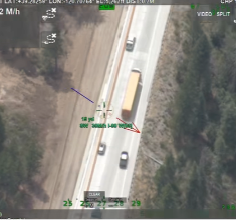
GOLD RUN, CALIFORNIA — Following a string of semi-truck brake fires on Interstate 80 in the Sierra Nevada foothills, the California Highway Patrol launched an aerial enforcement campaign on August 7 to catch commercial drivers skipping the mandatory brake check area between Nyack and Blue Canyon on westbound I-80.
CHP Gold Run Division partnered with CHP Air Operations and CHP Valley Division Commercial units for the I-80 Joint Commercial Enforcement Campaign. Aircraft spotted trucks bypassing the required brake check stop from above and radioed ground units to intercept and stop them for enforcement. Video from the operation shows the aerial unit identifying two commercial trucks that bypassed the brake check area before marked patrol units on the ground stopped them.
The campaign also targeted speeding and other violations that contribute to brake fires on the steep mountain descent.
“All semis must stop at the brake check area between Nyack and Blue Canyon on 80 westbound. Check to ensure your brakes cool before continuing down the mountain. Please do not park in this area for an extended period. If you decide to skip the mandatory brake check area, our eye in the sky will be watching,” CHP said.
The Gold Run Division had already conducted I-80 commercial enforcement in late July following recent brake fires in the corridor, including a July 23 incident near Colfax where a semi hauling 42,000 pounds of citric acid caught fire after a brake failure, sparking a brush fire and closing lanes for hours.
📸 Image(s) used under fair use for news reporting.


