

MCINTOSH COUNTY, GEORGIA — Two crashes on Interstate 95 in McIntosh County within hours of each other — both involving tractor-trailers parked on the shoulder — killed one person and injured another, closing both directions of the highway overnight and into Sunday morning and renewing attention on what truck drivers and industry researchers describe as a chronic, dangerous national truck parking shortage.
The First Crash
At 11:14 p.m. on October 4, a tractor-trailer traveling southbound on I-95 at mile marker 47 failed to maintain its lane and slammed into the back of another truck parked on the right shoulder. The force of the impact caused the at-fault truck to overturn onto its side. The driver of the parked truck was injured and transported to Southeast Georgia Health System in Brunswick. The overturned trailer was hauling isopropyl alcohol, a hazardous corrosive material. Hazmat did not respond but storm drains were dammed as a precaution. Some diesel spilled on the highway. All contents remained confined within the trailer.
All of I-95 southbound was closed until about 8:15 a.m. on October 5. Northbound was completely closed until 6:26 a.m. for cleanup and debris removal. Traffic was rerouted to Exit 49 southbound and Exit 42 northbound. GSP’s Specialized Collision Reconstruction Team, Commercial Vehicle Enforcement, McIntosh County Sheriff’s Office, Glynn County Police Department, and both McIntosh and Glynn County fire departments responded.
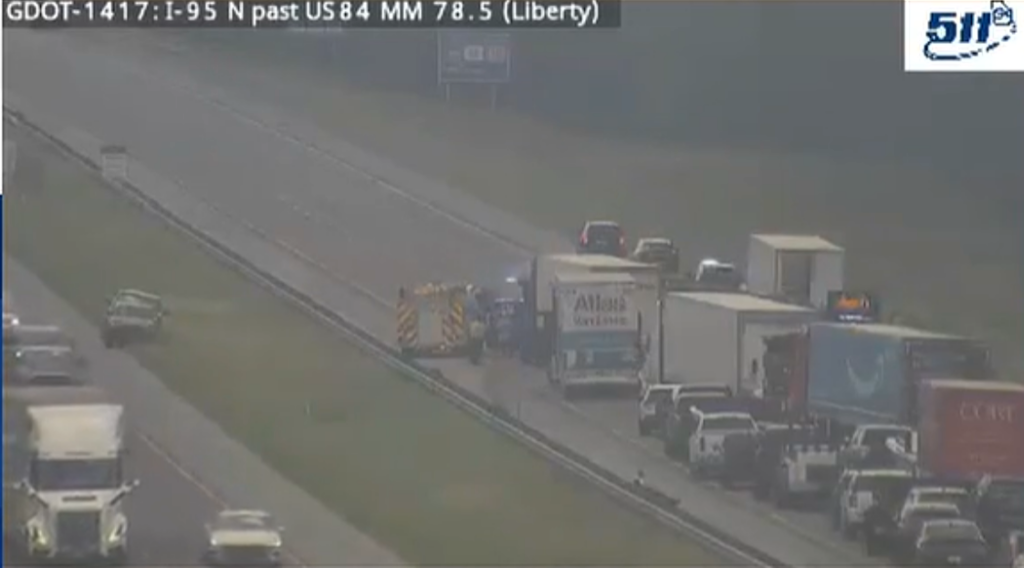
The Second Crash
While a trooper was en route to assist with traffic control from the first crash, a second crash was reported at 6:09 a.m. at mile marker 52. A sedan drove onto the right shoulder for unknown reasons and struck the rear trailer of a tractor-trailer parked on the shoulder. The sedan’s sole occupant was pronounced dead at the scene. The truck driver was not hurt. The far-right lane of I-95 southbound was closed until 9:37 a.m. for the investigation.
Both crashes remain under investigation.
The Parking Problem Behind the Crashes
The first crash was triggered in part by a parking situation that is all too familiar on this stretch of I-95. In that case, the parked tractor-trailer’s driver told troopers she had pulled onto the shoulder for a restroom break and was climbing back into the cab when she felt the impact.
Dan Murray of the American Transportation Research Institute said I-95 is the most congested freight corridor in the country with very few legal authorized parking options, forcing trucks onto shoulders and ramps. ATRI research found drivers spend an average of 56 minutes per day searching for authorized parking, costing them approximately $7,200 a year in lost pay.
OOIDA Executive Director Lewie Pugh said there is approximately one safe parking space for every 11 trucks on the road. Drivers who can’t find parking face a choice between violating hours-of-service rules or parking somewhere unsafe.
“You drive through there. There’s nowhere to park. So your only option is to get back on the highway and try to go farther to the next stop,” Pugh said. “And then what eventually happens is you don’t find anything, you run out of time. So you end up having to park somewhere unsafe.”
Long-haul driver Luis Alfonso, who regularly runs I-95 from Florida to New Jersey, said the stretch north from Jacksonville to Savannah offers almost no place to stop after 8 or 9 p.m. “It’s a lot of accidents because we don’t have a place to park,” he said. “At the end of the day, when you stop, you almost die. Mentally, you know?”
Pugh noted that a proposed truck stop near Savannah about four to five years ago was abandoned after community opposition. “We can’t have it both ways. We cannot have stocked store shelves and the goods and the products we want and not have trucks.”
A proposed $755 million federal Truck Parking Safety Improvement Act, which would provide competitive grants for new capacity, has cleared committee three times but has not received a House floor vote.
Interviews courtesy of local media.
📸 Image(s) used under fair use for news reporting.


