
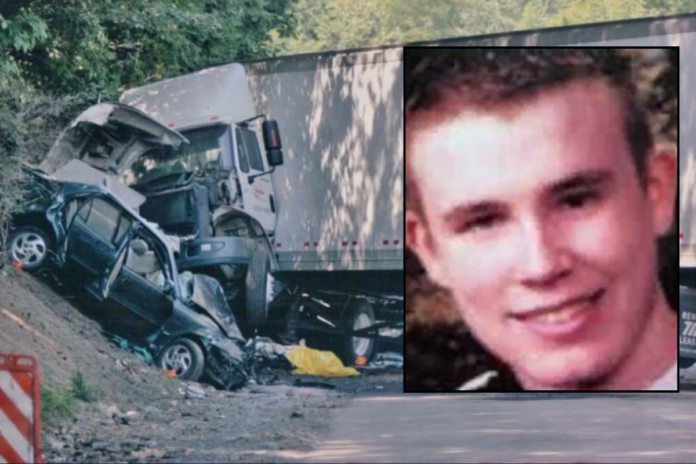
LANCASTER, PENNSYLVANIA — On the morning of July 5, 2010, Eileen Miller sat on her front porch and watched two state troopers pull up to her house. She said she immediately knew it involved her son. Paul Miller Jr. was 21 years old. A tractor-trailer driver had reached for a cell phone, lost control, crossed three lanes, went through a grassy median, and struck Paul’s car head-on, pushing it into an embankment. A van carrying 12 people then hit the tractor-trailer. Paul was the only person killed.
It took Eileen Miller 14 years to turn that morning into a law.
The Crash and What Followed
Miller said she did not initially know distracted driving had caused the crash. After crash reconstruction, she learned the truck driver had been reaching from one phone to another that was jammed under his seat. She made a promise at the morgue that she would find out what caused the crash and fight to change it.
She was originally told the driver would receive only probation. She fought for a stronger sentence. After the crash, the driver received another citation in New Jersey for phone use, as well as another unsafe driving citation. The judge ultimately rejected the plea deal and sentenced him to one to three years in prison. He served 17 months. After his release, Miller met with him. He admitted he had been distracted.

14 Years of Advocacy
Miller began contacting state representatives and traveling to the Capitol to advocate for a hands-free driving law. Pennsylvania already had a texting law, but Miller said it was difficult to enforce because officers could not easily tell whether someone was texting, scrolling, or doing something else. In her son’s case, the driver had not been texting at all.
Opposition came from multiple directions. Some objected on personal freedom grounds. Others did not want to give up phone use themselves. Some lawmakers wanted data to ensure enforcement would not lead to profiling, which Miller said she understood. She credited Pennsylvania State Sen. Rosemary Brown with helping move the legislation forward after hearing her story.
Paul Miller’s Law took effect on June 5, 2025. It makes handheld phone use while driving a primary offense, meaning police can stop a driver solely for holding a device. Drivers cannot use a handheld phone even while stopped in traffic, at a stop sign, or at a red light. They must pull off the road to make a call. Hands-free options such as Bluetooth or speakerphone remain permitted. Drivers cannot hold or support a phone with any part of their body.

Miller said she was proud the law finally passed because her son’s legacy would help save lives. At the same time, she said it was painful that it took losing him to get there. She said the best practice is for drivers to turn phones off completely and set navigation before getting on the road.
She has continued advocating on the roads. When she sees drivers using phones, she sometimes approaches them afterward and hands them a hands-free device. “They do not want to kill someone else or themselves,” she tells them.
Law Enforcement Perspective
Pennsylvania State Police Trooper James Grothey, public information officer for PSP Troop J, said distracted driving causes more crashes than impaired driving. Cell phones are a major source, but anything that takes a driver’s eyes off the road counts — reaching for objects, doing hair or makeup, dealing with children in the back seat, or looking at crashes on the side of the road.
Under Paul Miller’s Law, the base fine is $50. With court costs, the total runs approximately $180 to $200. Violations can affect a driver’s record, insurance rates, and employment, particularly for jobs that involve driving. Grothey said professional drivers should be held to a higher standard. He also noted that even hands-free conversations can be distracting if a driver’s attention drifts from the road.

AAA’s Perspective
Doni Lee Fox, public relations manager for AAA Central Penn, said the AAA Foundation for Traffic Safety’s most recent Traffic Safety Culture Index survey found that 90 to 97 percent of drivers acknowledged it was dangerous to text, read emails, or take phone calls while driving — yet 27 to 39 percent admitted doing it anyway.
Fox said publicizing statistics and strengthening laws are part of changing behavior. Her advice: set GPS, adjust the radio, handle climate controls, and settle children before getting on the road. Put the phone away and turn off notifications before driving.
Key Facts About Distracted Driving in Pennsylvania
Distracted driving killed 3,275 people nationwide in 2023, according to NHTSA. Pennsylvania court records show more than 9,000 distracted driving offenses between 2021 and 2025. Drivers in their 20s and 30s were the most common offenders. Violations peaked between 2 p.m. and 4 p.m. In the Susquehanna Valley in 2025, York County recorded the most distracted driving offenses at 102, followed by Lancaster, Dauphin, Franklin, Cumberland, Lebanon, Adams, and Perry counties. Juniata and Mifflin counties reported no offenses in 2025. Texting while driving is illegal in 49 states, the District of Columbia, and Puerto Rico.
Interview courtesy of WGAL 8.
📸 Image(s) used under fair use for news reporting.
